Filming the video is half the job. The other half is being found at the moment someone searches. YouTube SEO turns a video from an upload you forget about into an asset that brings views for years.
YouTube SEO at channel level
Individual videos can be optimised, but without channel structure the results never accumulate. At this stage we build a topic map: which queries are genuinely searched, which topics can become a series, and which video feeds which.
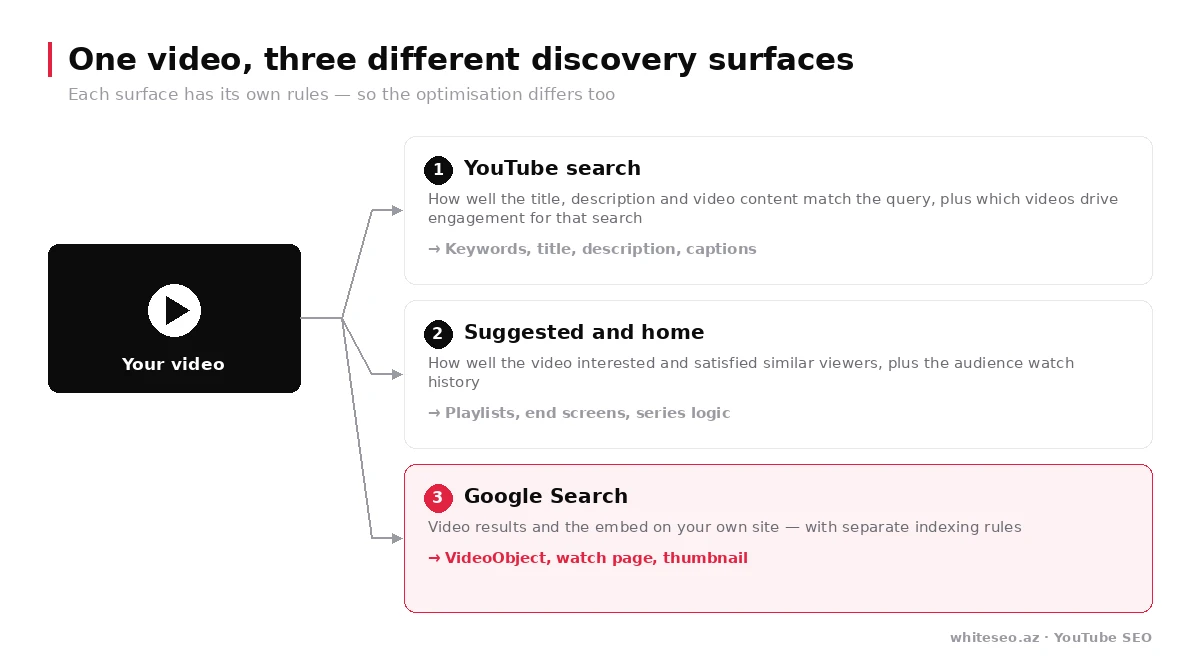
Playlists here aren't arbitrary grouping — they're the route that carries a viewer from one video to the next. On the home page and in suggestions, YouTube looks at "how well your video has interested and satisfied similar viewers" and at the audience's watch history; series logic feeds exactly that signal.
Optimising each video
YouTube's official explanation of search ranking is simple: "how well the title, description, and video content match the viewer's search" and "what videos drive the most engagement for a search". The first part is in your hands; the second depends on the quality of the video itself.
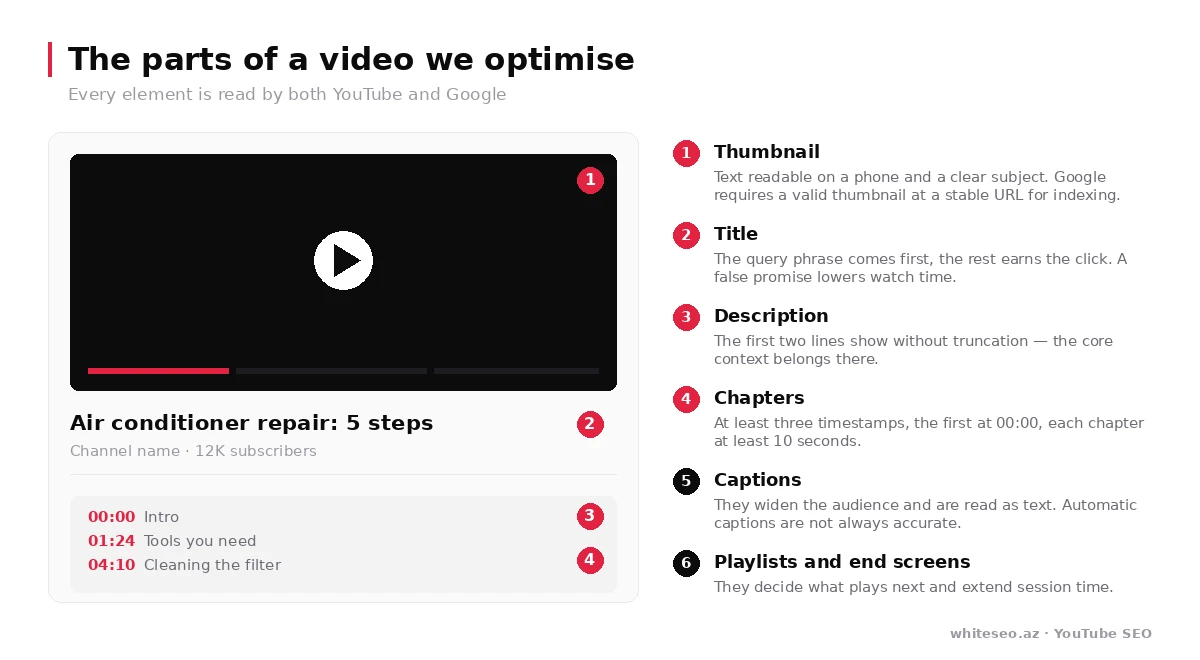
Chapters are usually forgotten, yet the rules are precise: at least three timestamps, the first one at 00:00, and each chapter at least 10 seconds long. Break those conditions and chapters simply don't appear.
Captions do two jobs. In YouTube's own words they let you "share your videos with a larger audience", and at the same time they are read as text. We don't rely on automatic captions — they are generated in the video's default language only and are not always accurate.
Videos on your own site: the video SEO side
Getting videos to show in Google Search is a separate job with documented conditions: the watch page must be indexed, the video must be embedded on that page, it can't be hidden behind other elements, and it needs a valid thumbnail at a stable URL.
One condition matters more than the rest: Google states that the indexed watch page must be performing well in Search before its video can be considered for indexing. Putting a video on a weak page achieves nothing — the page itself has to work.
This is where VideoObject structured data and key moments markup come in. Our general approach to structured data: schema markup and entity linking.
Monthly YouTube SEO work
| Work | When | Outcome |
|---|---|---|
| Channel and competitor audit | Kick-off | Gaps and realistic potential |
| Topic and query map | Kick-off | A list of what to film |
| Re-optimising the back catalogue | Months 1–2 | The fastest gain in views |
| Titles, descriptions, chapters, tags | Every video | Relevance in search |
| Thumbnail variants | Every video | More clicks |
| Captions and transcripts | Every video | Wider audience, a text signal |
| Video pages and schema on the site | Monthly | Google video results |
| Reporting | Monthly | Views, watch time, traffic sources |
The fastest-returning item is the third row: re-optimising videos you already have. Without filming anything new, fixing titles, descriptions and chapters is usually where the first growth comes from.
What we measure
View count alone isn't a report. The metrics we read from YouTube Analytics: impressions and click-through rate, average view duration, where traffic comes from (search, suggested, home) and subscriber growth.
There's a nuance in watch time: per YouTube's own explanation, relative watch time matters more for short videos and absolute watch time matters more for longer ones. A 45-second video and a 15-minute video are therefore not judged by the same yardstick — we separate them in the report.
What the YouTube SEO service costs depend on
- Video count — how many videos exist and how many will be re-optimised.
- Monthly rhythm — how many new videos ship each month.
- Number of languages — multilingual captions and descriptions are separate work.
- Thumbnail design — done by us or by your team.
- The website side — whether video pages and schema are included.
Videos also feed your site's overall visibility. If broader work is needed, this runs inside the SEO service; to start, an SEO audit opens up the picture. Package scope: SEO pricing.
Frequently asked questions
Do tags matter?
They do, but not much. YouTube foregrounds the title, description and the content of the video itself. Tags are mainly useful for spelling variants and misspellings — they don't deserve hours of work.
How many videos before YouTube SEO shows results?
There's no fixed number. On a channel with an existing catalogue the first growth can appear in 4–8 weeks, because old videos get re-optimised. On a channel starting from zero, meaningful flow usually takes 4–6 months.
Do you produce the videos too?
Filming isn't our job. We take the topic, script structure, titles and optimisation; production stays with your team or a partner studio.
Are Shorts included?
Yes, but with different logic. Shorts discovery works differently and relative watch time is decisive there. Long-form and short-form get separate plans.
If our videos are also on the site, does that count as duplication?
No. Embedding a YouTube-hosted video on your site causes no problem — on the contrary, a properly built watch page creates an additional chance to appear in Google video results.