Links from other sites are a trust signal for Google. This is also the area that attracts the most penalties — because links are easy to buy and hard to earn. Our backlink service is built on the second one.
How we earn backlinks
Data and research
We produce original numbers, surveys or analysis for your field. Material like that gets cited naturally — because nobody else has it. The method for building depth on a topic: topical authority and content clusters.
Expert articles
Bylined pieces on relevant publications with a real audience. We don't work with mass guest-post networks: one strong placement is worth more than thirty weak ones.
Digital PR and media
Newsworthy angles are pitched to journalists and trade media. The result is both a link and a brand mention.
Broken link reclamation
We find dead links on competitor and industry sites and offer your relevant page instead. One of the fastest and safest methods there is.
Existing relationships
Partners, suppliers, customers, associations you belong to, events you sponsor. These links are usually missing simply because nobody asked for them.
Methods we never use to build backlinks
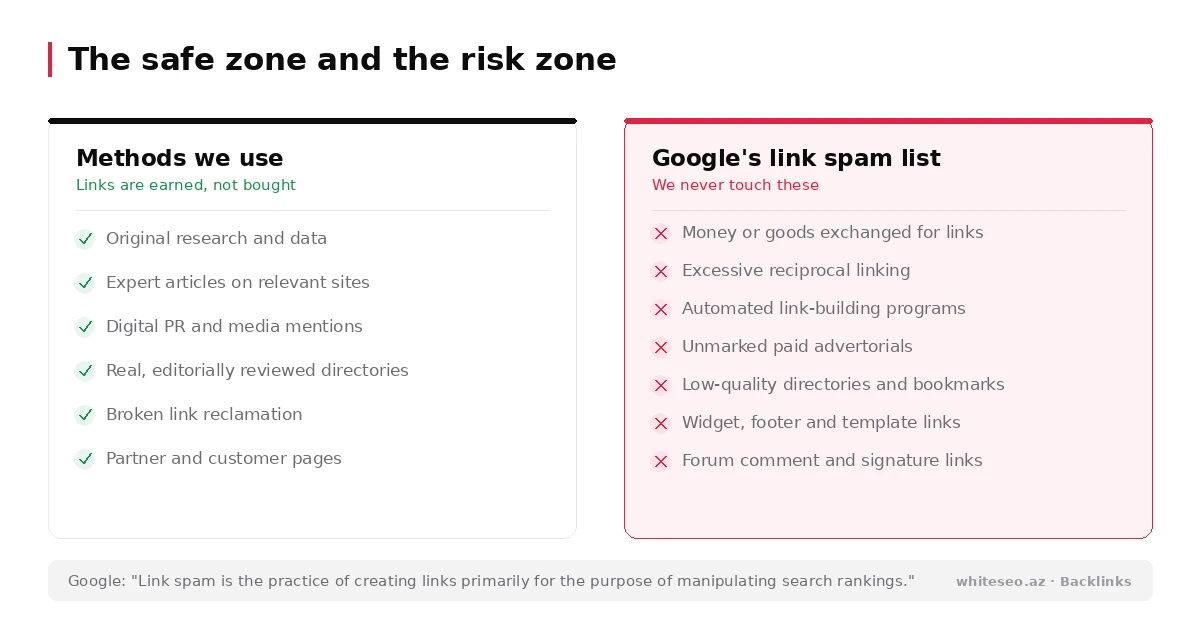
Google defines link spam as "creating links to or from a site primarily for the purpose of manipulating search rankings". The official list includes exchanging money or goods for links, excessive link exchanges, automated link programs, unmarked paid advertorials, low-quality directories, widget and footer links, and forum comments.
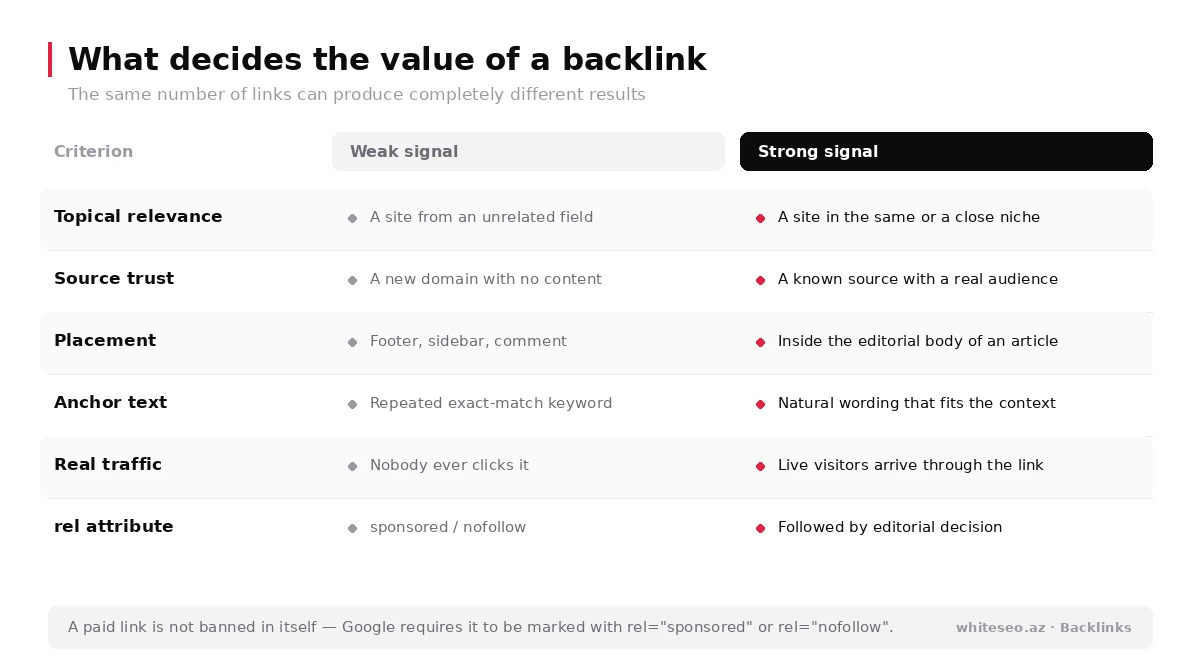
One important nuance: a paid link is not banned in itself. Google requires it to carry rel="sponsored" or rel="nofollow". But such a link passes no ranking credit — which means anyone selling "followed links" is, by definition, offering a policy violation. Sites that buy them end up with an "Unnatural links to your site" manual action in Search Console.
Monthly backlink work and reporting
| Work | When | Outcome |
|---|---|---|
| Backlink profile audit | Kick-off | Current state and risks |
| Competitor profile analysis | Kick-off | A realistic target: which sources are needed |
| Producing link-worthy content | Monthly | A reason to be cited |
| Outreach and negotiation | Monthly | New placements |
| Anchor distribution monitoring | Monthly | A natural profile, lower penalty risk |
| Verification of new links | Monthly | Lost and altered links recovered |
| Reporting | Monthly | Links earned, source quality, trend |
Backlink count alone isn't treated as a metric in the report. For every placement we state the source, topical fit, placement position and anchor — so you can check each one yourself if you want to.
If you already have harmful backlinks
A questionable backlink profile left over from a previous vendor is a common situation. The first step is measuring reality: is there a manual action in Search Console, which sources are problematic, and can the links be removed at source.
A disavow file is a last resort, not a first step. In Google's own words it is an "advanced feature" and using it incorrectly can harm your site; the documentation states plainly that most sites will not need this tool. So we only apply it when there is a genuine reason.
What the backlink service costs depend on
- Niche and competition — in some fields quality sources are far harder to find.
- Monthly target — how many new placements are planned.
- Language and geography — local, regional or international sources.
- Content production — whether we create the material or you supply it.
- Cleaning up an existing profile — extra work if legacy problem links exist.
What the packages cover overall: SEO pricing.
Link building rarely works in isolation. If the technical base isn't ready, the effect of an earned link is lost — in that case the work runs alongside technical SEO or inside the SEO service.
Frequently asked questions
How many backlinks do we need?
There's no fixed number. The target comes out of competitor profiles: which sources, at what quality, and at what pace. Setting a count target and compromising on quality to hit it is the most common mistake in this field.
What Domain Rating / Domain Authority should we aim for?
Those are proprietary metrics from Ahrefs and Moz — not official Google measures. We use them only as a first filter; the decision is made on topical fit, real traffic and editorial quality.
When do results appear?
First placements land within 3–6 weeks; the ranking effect is usually readable after 2–4 months. A link's impact also depends on your content and technical state.
Are nofollow links useless?
No. They pass no ranking credit, but they bring real traffic, brand visibility and an audience. A natural profile contains both followed and nofollowed links — a profile made entirely of followed links looks suspicious in itself.
Is there a penalty risk?
With methods that don't break the policies, the risk is minimal. The main source of risk is links acquired in the past — which is why the work always starts with an audit of the existing profile.